Workplace ASD Accessibility Toolkit (WAAT) – Cross Platform Assistive Technology System
Course: Assistive Technology and Accessibility Research, MS HCC
Overview:
Process & Contributions:
Designed the Workplace ASD Accessibility Toolkit (WAAT), a cross-platform assistive technology system (mobile + desktop web) to support autistic adults in professional environments.
The project addressed the fragmentation of existing tools by integrating executive functioning support, workplace communication scaffolding, and sensory regulation into one cohesive system. Grounded in the Human Activity Assistive Technology (HAAT) framework and Universal Design principles, WAAT focuses on reducing structural workplace barriers rather than adapting the individual to rigid systems.
1. Research & Problem Framing
Conducted a structured literature review on employment-related assistive technology for autistic adults to identify systemic gaps in adult-focused workplace support.
Synthesized research findings highlighting three primary workplace barriers:
Executive functioning challenges
Social-communication demands
Sensory overstimulation
Analyzed limitations of current solutions (VR interview tools, productivity apps, standalone sensory tools) and identified the need for a context-aware, integrated system rather than isolated interventions.
Grounded the solution in the HAAT model (Human, Activity, Assistive Technology, Context) to ensure alignment between user traits, workplace demands, and environmental factors.
2. System Architecture & Interaction Design
Designed WAAT as a dual-platform toolkit (mobile + desktop web) to support real-world workplace workflows.
Structured the system into three integrated modules:
Executive Functioning Module
Adaptive scheduling and structured reminders
Task breakdown into incremental, time-boxed steps
Visual triage system (High/Medium/Low priority)
Explicit deadline indicators
Hierarchical subtask visualization to reduce cognitive overload
Communication Support Module
Interview preparation scaffolding with strategy tips and templates
Explicit breakdown of workplace norms (communication protocols, social dynamics, accommodations)
Textual Composition Assistant with tone and structure feedback for professional emails
Sensory Regulation Module
Environmental awareness tools
Coping strategy recommendations
Context-sensitive support integrated into the workflow
Designed the dashboard as a central navigation hub featuring:
Quantitative progress visualization
Modular tool cards
Explicit visualization of the HAAT framework to reinforce system logic
3. Prototyping & Evaluation
Developed a high-fidelity interactive prototype demonstrating mobile and desktop workflows.
Moved beyond static usability testing by incorporating:
Contextual walkthroughs
Persona-based assessments
Applied cognitive walkthrough methods to evaluate task clarity and real-world workplace applicability.
Acknowledged prototype-stage constraints, including backend AI simulation (“Wizard of Oz” approach), enterprise integration limitations, and the need for longitudinal validation.
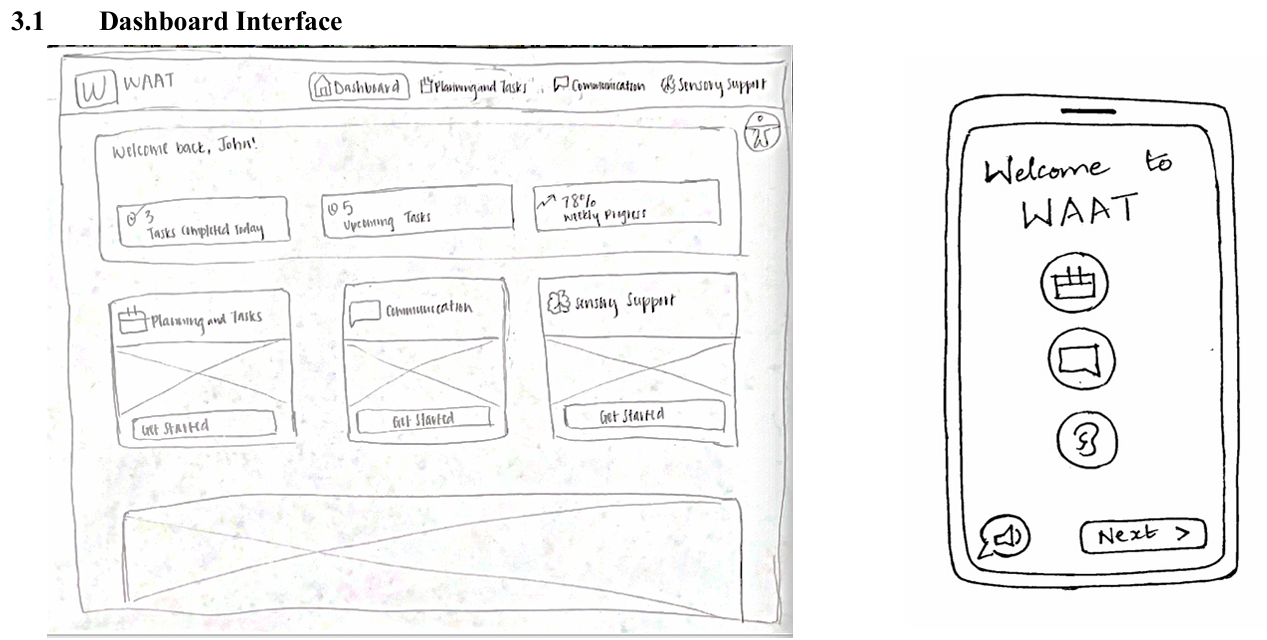
Desktop and Mobile Low Fidelity Sketches of Dashboard Interface
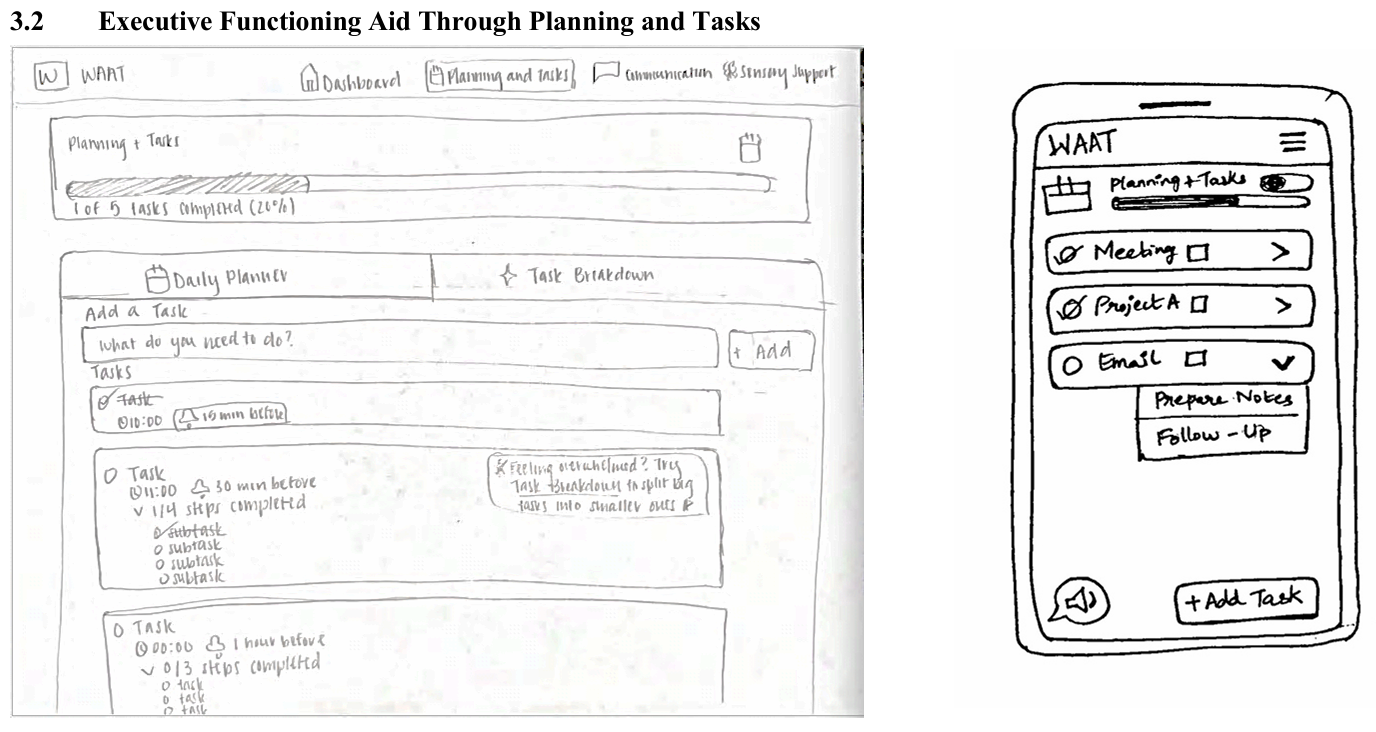
Desktop and Mobile Low Fidelity Sketches of Planning and Tasks Page
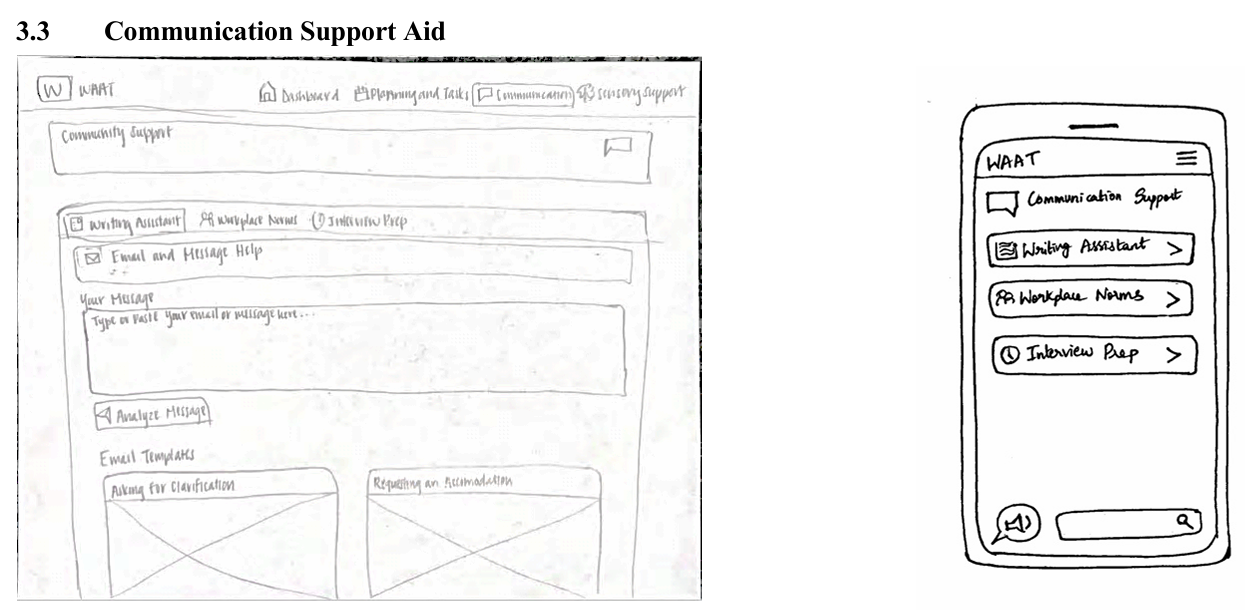
Desktop and Mobile Low Fidelity Sketches of Communication Support Page
Outcome & Impact:
Proposed a unified assistive technology ecosystem that integrates executive functioning, communication, and sensory regulation instead of fragmenting them across multiple tools.
Operationalized the Social Model of Disability by shifting the focus from correcting the individual to mitigating environmental and structural workplace barriers.
Outlined a future roadmap including AI-driven personalization, wearable integration for stress detection, employer-facing modules, and long-term effectiveness studies to support sustainable employment outcomes.